A Fantastical Mirror
Nostalgia, connection, and resistance

When I was a kid growing up in the ’70s and ’80s, facing the very tangible threat of bullies and the more existential threat posed by the Soviet Union and nuclear war, I found comfort in fantastical stories: Tolkien, Lloyd Alexander, Dungeons and Dragons, and most especially Star Wars. They all spun exciting tales of a group of disparate individuals facing cruel, authoritarian foes. In the case of D&D, my friends and I took it one step further and spun our own versions of those stories. But for me, Star Wars, with its plucky Rebellion facing off against a massive, despotic Empire, was the most ubiquitous rejection of fascism I’d seen in popular media.
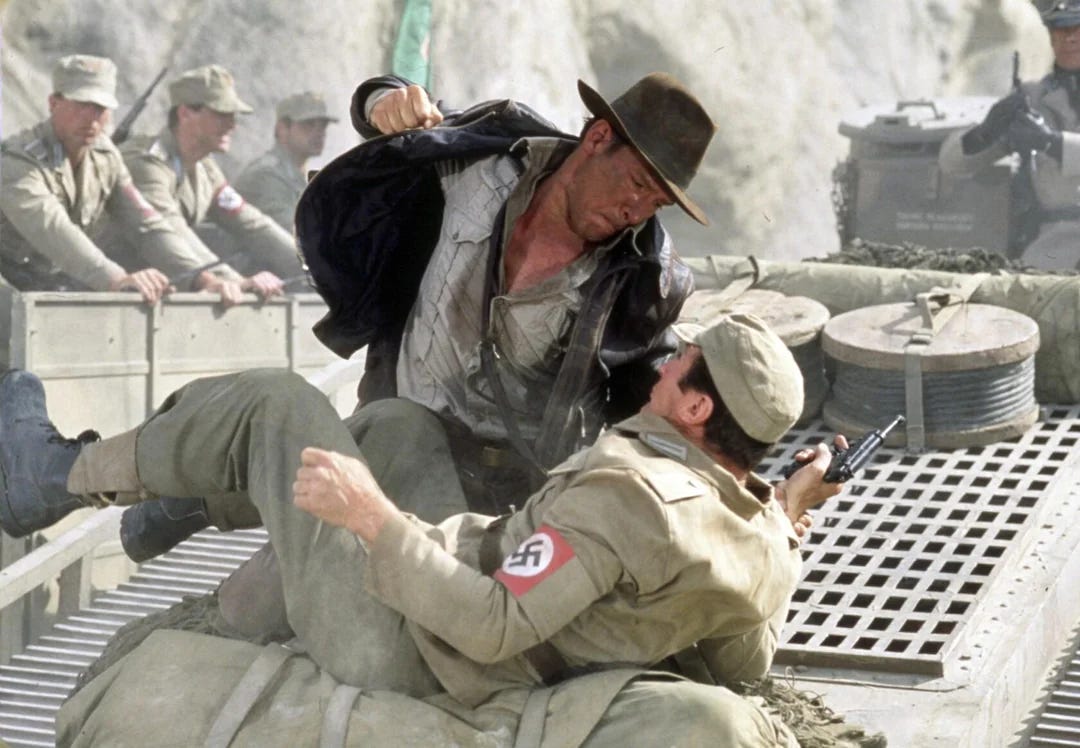
Not that, at the time, I thought of Star Wars as some sort of primer for how to deal with an authoritarian regime—I just liked the Force and lightsabers and the Millennium Falcon. But I understood that the Empire was bad and the Emperor was evil, in the same way that, as the grandson of a WWII veteran, I understood Nazis and fascism were bad. Luke Skywalker’s journey from farm boy to Jedi and Darth Vader’s redemption arc resonated with my generation on an almost molecular level, and one reason I think they did was because their individual stories were framed by a galaxy-wide conflict between freedom and tyranny.
Today, as an adult in 2026 witnessing cruelty and authoritarianism on a scale I had thought consigned to the trash bin of history, I continue to find comfort in fantastical stories. The Lord of the Rings films, coming as they did in the immediate wake of 9/11, were stark reminders of a very real conflict between freedom and tyranny, and of the power of a group of individuals to stand against darkness. The MCU, which contains perhaps the most unique series of interconnected films ever made, all derive from comic book stories about superheroes. Escapist stuff on one level, sure. But in Captain America: The Winter Soldier, when Nick Fury tells Steve Rogers that SHIELD is about to have a fleet of armed helicarriers deployed to neutralize threats before they even happen, Cap tells Fury that this isn’t freedom; this is fear. I still get goosebumps at that scene. I wish Steve Rogers could pay a visit to the Pentagon, or the White House, and dispense some of that wisdom. And the whole Infinity War saga revolves around a committed, powerful antagonist, motivated by a pure ideology, opposed by disparate heroes who have just recently been tearing themselves apart over fundamental differences in how to keep the world safe and free.
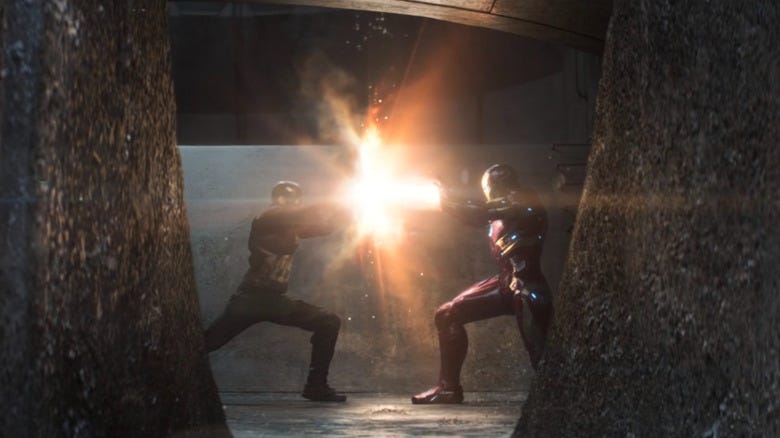
But perhaps the fantastical stories that have recently had the most impact on me have come from television, specifically two series: Stranger Things and Andor. Both rely on nostalgia, albeit in different ways, but beyond good marketing strategy aimed at GenXers like myself, their use of nostalgia taps into something deeply rooted in our childhoods—the power of personal connection, and the nature of the struggle between freedom and tyranny.
Stranger Things is a love letter to the 1980s, specifically to suburban childhoods in small-town America. Yes, it deals with government conspiracies, scientific experiments, other dimensions, psychic and telekinetic powers, and horrific monsters, both human and non-human. It also examines friendships, innocence (and its loss), insecurities, growing up, bullying, and the power of the imagination.
Mike, Will, Lucas, and Dustin are the core group of characters, friends who play D&D in Mike’s basement. They are intelligent, sensitive, often hilarious, and love to imagine other worlds. Socially, they are nerds. But so were a lot of us in middle and high school, and they become our nerds. And when Will goes missing and his friends search for him, they come across a young girl with a shaved head who has just escaped some sort of lab, a girl of few words with the number 011 tattooed on her arm. She responds to the name Eleven, and naturally the kids shorten that to El. It turns out El has what can only be described as superpowers, which will be needed as the laboratory she has escaped from has conducted experiments that have opened a rift to another dimension, allowing a hideous, violent creature to enter our world, an eyeless humanoid with an enormous mouth that opens like the petals of a Venus flytrap. Our D&D-playing heroes naturally name the monster the Demogorgon.
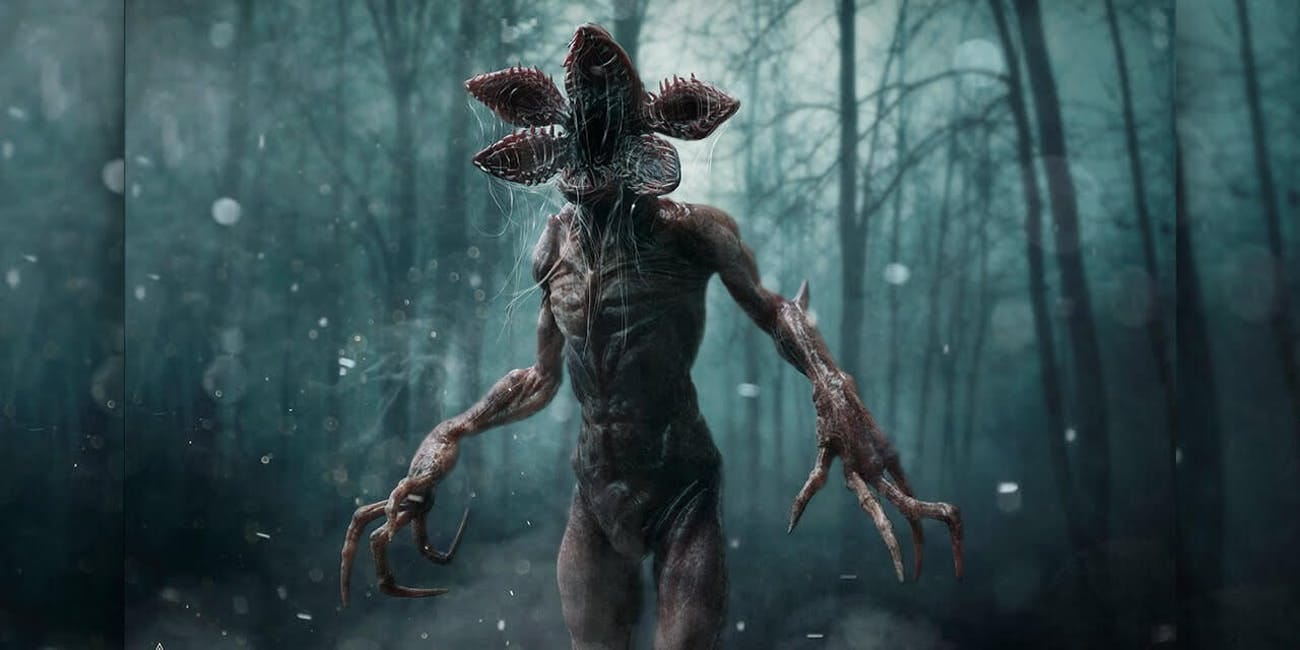
They also believe their missing friend Will has fallen into this other dimension, which is a darker version of our own world that the kids name the Upside Down. So the kids, with the help of El and various others—Mike’s older sister Nancy, Will’s older brother Jonathan, older cool kid/bully Steve Harrington, Will’s mom Joyce, and the town police chief Hopper—must rescue Will and defeat the Demogorgon, while avoiding the government assassins searching for El, and them.
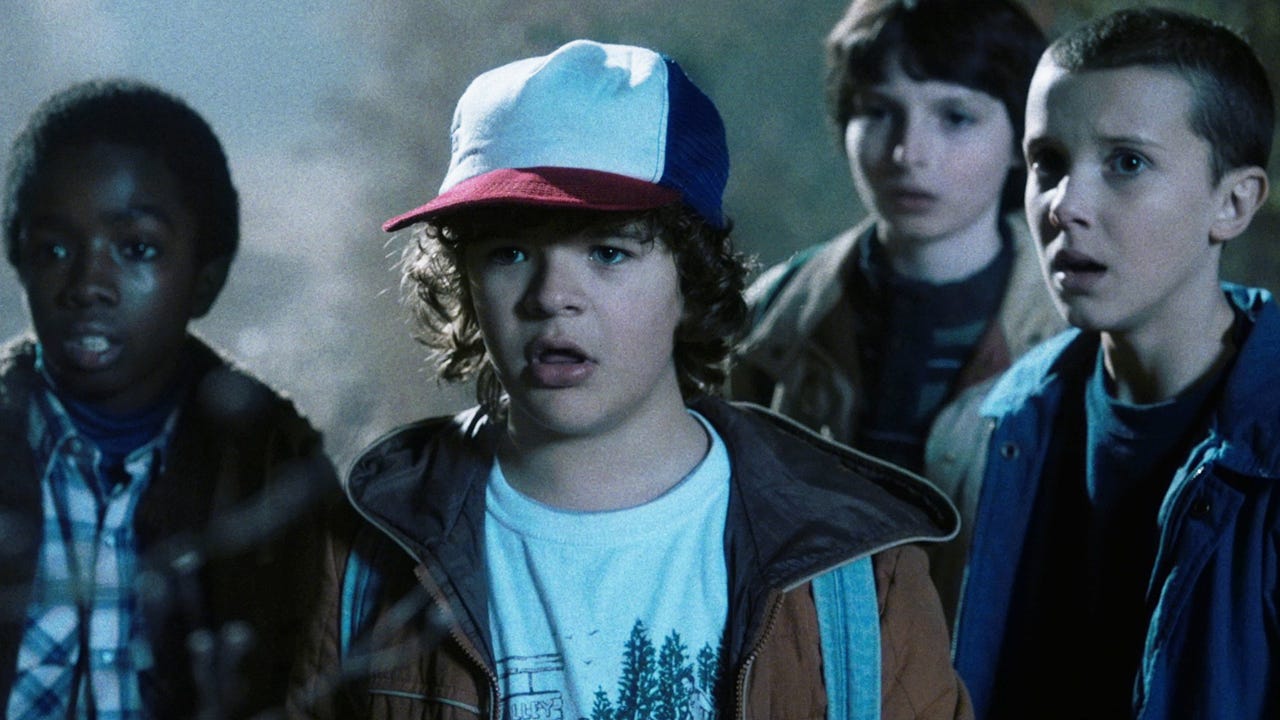
For five seasons spread out over a decade, Stranger Things expands upon this world, a meticulously recreated version of the 1980s complete with shopping malls, kids on bikes, walkie-talkies, checked-out parents, and a killer soundtrack. And the characters grow and change: Steve’s arc from bully to hero is earned, as is Nancy’s arc from shy teenager to girlboss. And ***spoiler alert*** Will Byers goes from largely-absent victim in Season 1 to sorcerer in Season 5. (The below table read of S5 E4, when the cast learns of Will’s transformation, is delightful to watch—just look at all the actors’ faces.)
What the show does so well, beyond the conspiracy-theory/inter-dimensional monster thrills, is that it understands and shows the friendship dynamics of kids as they grow older and face conflict. Sure, none of us had to deal with psychic monsters, alternate dimensions, and secret government forces hunting us down. But when Mike and El become romantically interested in one another1, and Will confronts Mike for not wanting to play D&D anymore because he’s too interested in his girlfriend, only for Mike to shoot back that they aren’t kids anymore…that kind of hurt registers in a very real way for viewers. All of us had friends we grew apart from during the long haul through middle and high school. It’s not the same as breaking up with your first love, but it’s just as universal.
But these friends, as fractured as their relationships become, stick together when it really counts. They literally save the world and each other. In the face of overwhelming odds, they believe they can win. They take risks. They trust one another. For all the adults in Stranger Things that manipulate and threaten our heroes, the kids end up being all right, mostly. Their connections with one another sustain them, and us. I mean, who doesn’t love Dustin and Steve’s friendship?
The finale for Stranger Things has its issues, such as plot holes (***minor spoiler*** so, the military just…let them all go?). But the final scene with Mike, Will, Lucas, Dustin, and Max is as perfect a closing scene as I’ve ever watched.2
As for Andor: if you’d told 13-year-old me that four decades later I’d be watching a Star Wars-based TV show without any Jedi or even a single lightsaber, and that it would be a monumental work of fiction that would also be extremely relevant to the political reality of the 21st century, I’d have thought you were full of Bantha poodoo.
Star Wars has come a long way from the Ewoks of ROTJ, the excruciating dialogue foisted on Hayden Christensen and Natalie Portman in the prequel trilogy, or even the kerfuffles around how Luke Skywalker and Rey were used in the sequel trilogy. The Mandalorian was a cool TV show with a Western vibe, at least in season 1 and arguably most of season 2. Kenobi gave us more insight into a now-older and somewhat despairing Obi-Wan Kenobi, along with the fan-service reunion of Kenobi with his former pupil, Anakin Skywalker, now Darth Vader. And Rogue One showed how the Star Wars universe could handle other types of stories beyond Jedi vs. Sith.3
But Andor is its own thing. Which seems odd as it’s technically a prequel to Rogue One about how Cassian Andor (Diego Luna) became a Rebel operative. You don’t have to have seen Rogue One to watch Andor. In fact, you don’t need to know much at all about Star Wars to watch Andor. In the Star Wars canon, Andor is the furthest departure from the anthology films. We meet Cassian as a thief and scavenger, searching for his missing sister. An unfortunate confrontation with two corporate security officers results in Cassian accidentally killing one, then murdering the other. On the run, Cassian meets the mysterious Luthen Rael, expertly played with weary but dogged ruthlessness by Stellan Skarsgård. Luthen offers Cassian both an escape and a purpose: to become an operative in Luthen’s rebel network.
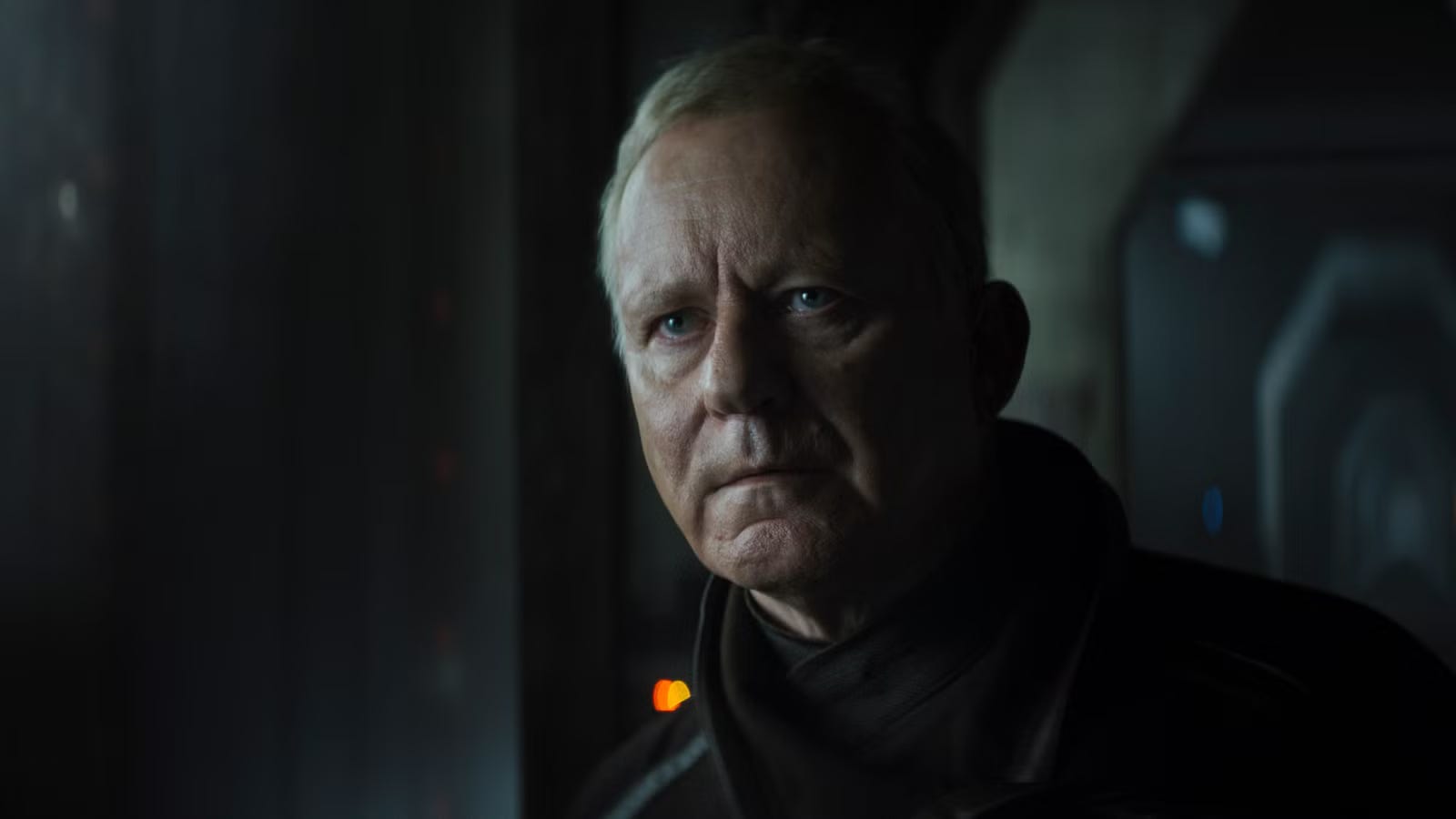
This could be a straight-up noir crime story. Instead, it’s perhaps the best Star Wars property. And it succeeds because it both lives in the tradition of Star Wars and has stepped out of that franchise’s very long shadow.
I’m a big fan of Alan Furst, author of numerous WWII-era historical thrillers—his Night Soldiers (1988) is one of my favorites. Furst is meticulous about both his world building and his characterization. His novels cover a narrow but rich period of history, specifically Europe from the early 1930s to 1945. His heroes are, for the most part, civilians who find themselves involved in dangerous espionage work against the Third Reich. We know how the story will turn out eventually—Hitler will be defeated—but we don’t know how it will turn out for our heroes.
This is the same dynamic at play in Andor, except we are witnessing the galaxy five years before the events of Rogue One and Star Wars: A New Hope. The Jedi have been killed or scattered. The Senate still exists, but the Emperor is fully in control. We know what will happen to the Empire eventually, but the characters in the show don’t. For them, the Empire must appear as Hitler’s regime appeared to the Nazis—a thousand-year Reich, eternal and dominant. And we see behind the scenes of the Empire via the ISB, the Imperial Security Bureau, the Empire’s Gestapo. There’s a banality to their work, the political sniping and in-fighting between various players all wanting to attain more clout and gain the respect of their immediate superior, Major Partagaz. Whenever Partagaz mentions Emperor Palpatine, you can see the reactions of the other ISB officers—fear wrapped in a more-or-less naked desire for power.
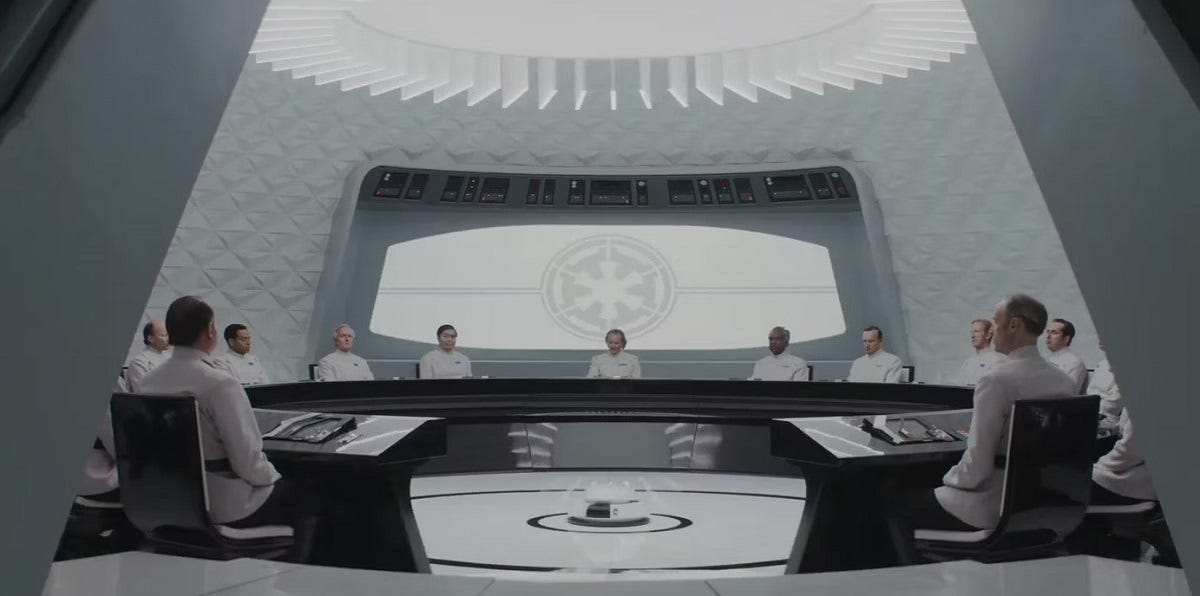
At this point, there is no well-established Rebellion engaged in strategic armed conflict with the Galactic Empire. Instead, there is a loose collection of various groups resisting the rising tide of autocracy as best they can. Luthen is one of the most effective revolutionary leaders, a man who, as he puts it, has sacrificed everything to resist and defeat the Empire. And he reads people very well. He sees Cassian Andor is a cynic who is nevertheless driven by a need to save others, motivated by the tragic and unresolved loss of his sister. At first Cassian seems to be putty in Luthen’s hands. But soon Cassian displays his own strength of will, choosing to get involved in the fight—a fight that soon becomes quite real, and quite dangerous.
What we are witnessing in Andor is the dark underbelly of the Rebellion, or of any rebellion: the need for spies, for ruthlessness, for deceit and treachery, for sacrifice—even of others who don’t know they are being sacrificed until it is too late. Luthen is less a hero than a spider sitting in the middle of a very complicated web. He knows how the Empire works, and he is willing to morally compromise himself to destroy it. For his part, Cassian navigates this shadow world quite well, trying to hold on to himself and to his lover, Bix, while wearing a series of masks as he travels across the galaxy on missions for Luthen.
And I haven’t even mentioned Syril Karn, the Imperial civil servant who becomes obsessed with finding Andor; Saw Gerrera, the possibly insane revolutionary who leads a militant insurgent group; and Orson Krennic, the director of advanced weapons research for the Imperial military, reprising his role from Rogue One. Played by Ben Mendelsohn, Krennic is the best villain: intelligent, charming, and possessed of an impressive collection of smirks, each more terrifying than the last.4
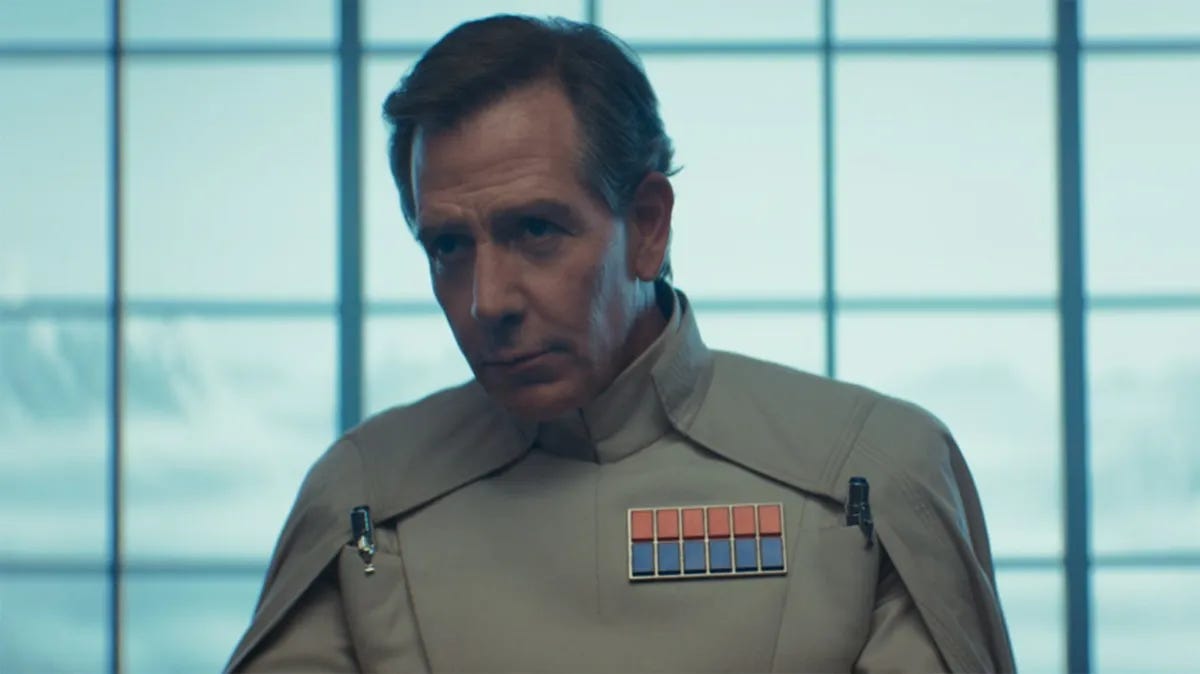
Along with its mature themes, deep characterization, and excellent writing, Andor contains some of the greatest monologues in television: Luthen’s explanation of what he has sacrificed, referenced and linked above; Nemik’s manifesto about the nature of rebellion and the unnaturalness of tyranny; Maarva’s stirring monologue, played at her own memorial, calling upon people to wake up and fight; Kino Loy’s impassioned speech to his fellow prisoners on Narkina 5 to rise up and escape.
But is is Mon Mothma’s Senate speech that had me gaping open-mouthed. It is difficult to deliver a speech against tyranny without sounding didactic or trite. But Genevieve O’Reilly delivers.
It’s worth quoting some of Mon Mothma’s speech:
The distance between what is said and what is known to be true has become an abyss. Of all the things at risk, the loss of an objective reality is perhaps the most dangerous. The death of truth is the ultimate victory of evil. When truth leaves us, when we let it slip away, when it is ripped from our hands, we become vulnerable to the appetite of whatever monster screams the loudest…
And the monster screaming the loudest? The monster’s we’ve helped create? The monster who will come for us all soon enough is Emperor Palpatine!
Remove “Emperor Palpatine” and this could be a speech delivered today in the United States Senate. Or the United Nations.
Most of us have felt this divide between what is said and what is known to be true for a while now. Certain media outlets exacerbated this divide, but over the past ten years this wholesale disregard for the truth has metastasized like a cancer on our society. Politics has become bloodsport. Partisan loyalty overrides critical thinking. Demonization of one’s opponent banishes rational argument. And now the very existence of objective reality is in danger of being lost. The death of truth is the ultimate victory of evil.
The fact that a television show set in the Star Wars universe stated this so forcefully and so eloquently, with more impact than a hundred talking heads on Sunday talk shows, is both mind-boggling and a cause for hope.
We live in a world of monsters. They don’t come from other dimensions, and they don’t fly TIE fighters or construct planet-killing spaceships. They look like us—living, breathing humans. Sometimes the monsters are inside ourselves, at war with our better angels. We see our leaders say and do awful things and feel we can’t do anything. And even if we felt we could do something, the courage to do so can be hard to find. It’s easier to sit down and stay quiet, to imagine that someone else will come to solve the problem, that nothing bad will happen to us if we just hide or pretend things aren’t as bad as they are.
That’s a nice thought. But it’s not real. And the something required doesn’t mean charging at a line of Stormtroopers or taking on a Demogorgon with a nail-spiked bat. All we need is to accept and acknowledge the truth, and to share it, and then to act upon it as we are able.
Stories help us to both acknowledge and share the truth. It’s up to us to choose how to act on it. So I’m going to work on strengthening my bonds with friends and family, holding fast and listening to those I love, just like the kids from Stranger Things. And I’m going to do what I can when I can, through my vote and my voice and my writing, to push back against the corruption of truth.
To be the heroes of our own world, all we need to do is acknowledge who the villains are and act. And why should we do this? I’ll let Cassian, speaking to a scared young operative, explain:
This makes it worth it. This. Right now. Being with you. Being here at the moment you step into the circle. Look at me. You made this decision long ago. The Empire cannot win. You’ll never feel right unless you’re doing what you can to stop them. You’re coming home to yourself. You’ve become more than your fear. Let that protect you.
Amen.
(And Steve & Nancy, and Jonathan & Nancy, and Lucas & Max, and Dustin & Suzie…)
I wish Lost (2004-2010) had ended this well. Or just ended well, actually.
Immediately after watching all of Andor, my younger son and I rewatched Rogue One, and I was immediately struck by how rushed Rogue One felt compared to Andor, how slight the characters in the film felt compared to the TV show. Rogue One is a great film, but the comparison just highlighted for me how much deeper television can go in terms of characterization and theme. Disney’s WandaVision does something similar with Wanda Maximoff and Vision—their total screen time in all the MCU films prior to WandaVision is far less than the attention they receive, and deserve, in their own TV show.
Watch Krennic’s interrogation of Dedra Meero for a master class from Ben Mendelsohn in how to be simultaneously terrifying and entertaining as hell.
Lovely stuff Chris! I’ve Subscribed, dear sir, looking forward to reading more in due course. Of course! ;)
Good to see you on here mate!
Beautiful essay. Thank you!